

Getaways
Do you know where you're going to?


They were like the men and women who stand about at airports and rail stations: they want to go away, and most of all they want to go away from themselves. For they do not know that they would carry their gloves of boredom with them wherever they went.” — John Steinbeck, Sea of Cortez
Steinbeck was referring to the idle men on the pier in San Diego looking on as he and biologist Edward F. Ricketts, together with their crew, resupplied The Western Flyer in preparation for their scientific voyage to the Sea of Cortez in 1940.
It’s a striking quote that came to me in a flash of memory earlier this week when an acquaintance told me that he and his wife were heading off for a four-day getaway to a timeshare in Port Canaveral.
We live in a resort community of mostly retirees about an hour and a half from Port Canaveral. We have no bosses or long commutes or teenagers to stress us out. Our community offers boundless opportunities for fitness, social and intellectual engagement.
What exactly do they need to “get away” from, and why does Port Canaveral satisfy as a destination? Such “getaways” are a common thing for them. They returned from a ten-day cruise to Alaska less than a month ago. Before that they went on a four-day Caribbean cruise, which they didn’t like.
Boredom is the only reason I can arrive at for their frequent travel. Their lives in our community are, perhaps, too predictable. Boredom, it seems to me, is a consequence of a lack of imagination. Particularly if Port Canaveral is enough to satisfy it. But of course it won’t be. A timeshare overlooking a cruise ship terminal doesn’t strike me as stimulating stuff. So, this leads me to wonder if in their case Steinbeck read the problem correctly—it’s themselves they’re trying to escape, which is of course impossible. For this reason they will continue on endless “getaways” and never escape a nagging sense of discontent.
Creative types are rarely bored. Of course I’m speaking mostly for myself here. It isn’t as though I’ve never experienced boredom, though. But instead of a “getaway” I lean in to it and create something, engage with art, these essays, my garden, ingredients in my refrigerator. Most importantly, I seek to make my own company interesting by exploring my inner world through these creative activities.
For me, travel isn’t a distraction from daily life so much as a call to adventure. In other words it stems from curiosity, not from a wish to escape but a call to knowledge. It’s intentional.
I have a hard time believing that a condo with a view of the Disney Cruise dock solves the problem of the doldrums. It’s merely a change in scenery. Scenery is static. What shifts is the weather. The watcher and watched remain essentially the same.
The getaway isn’t what matters; it’s knowing why you left and whether you’ve arrived that counts for something.
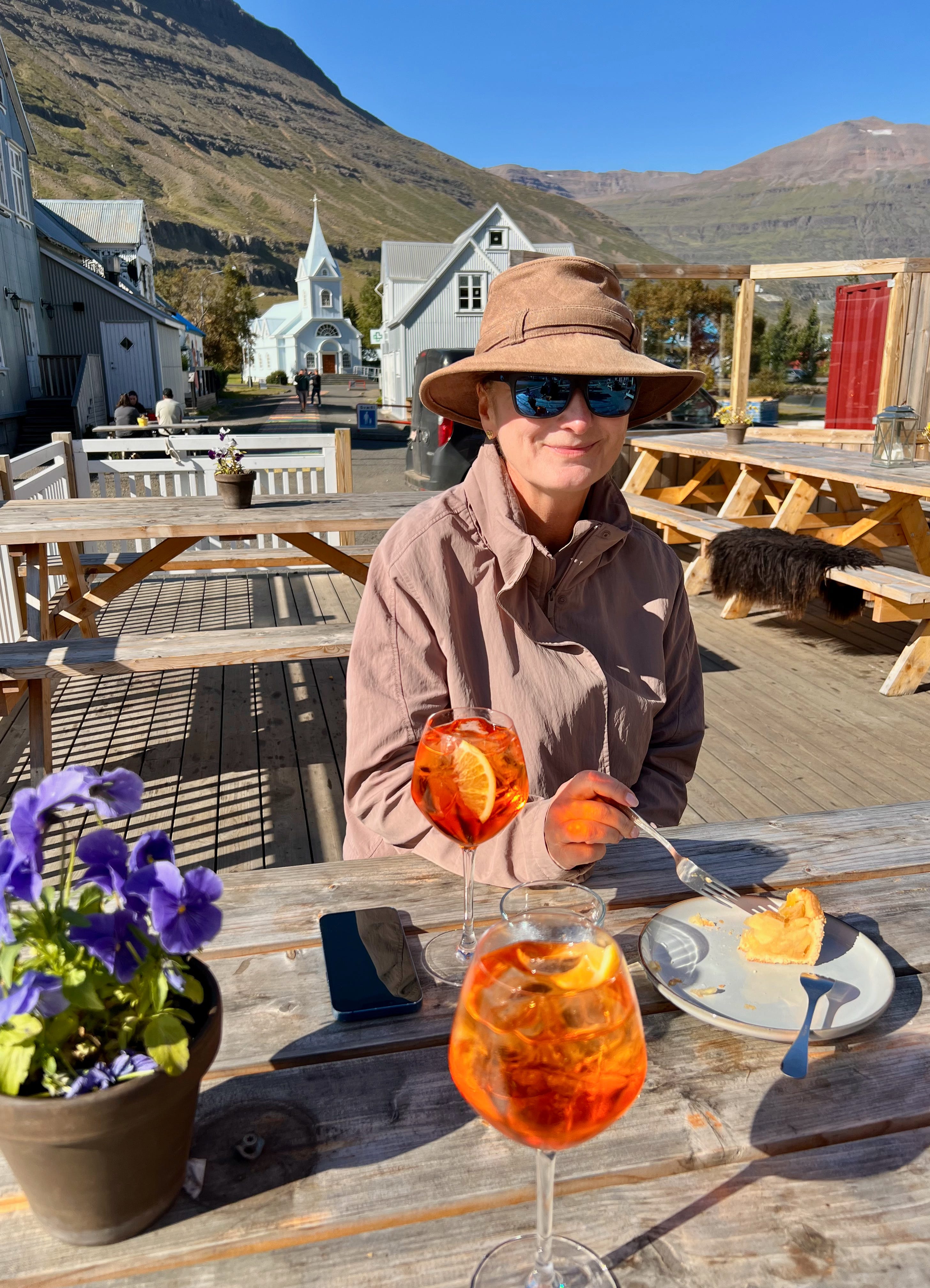
Where have you been? Where are you going? What do you seek there? Tell me about your getaways.

Reading Now
Currently I’m reading The Spiral Staircase: My Climb Out of Darkness by Karen Armstrong. A memoir first published in 2004, it’s a kind of get away and arrival story.
In the book Armstrong confronts the time in her life shortly after she left the convent she joined in 1962 when she was just seventeen years old. She spent seven years as a nun, missing the entire cultural revolution of the 1960s. In 1969, following her dispensation from the Vatican, she moved into St. Anne’s college at Oxford University.
In the years that followed she realized how profoundly her experience at the convent had left her unprepared for normal relationships. The emotional isolation of convent life and the cruelty perpetuated by the senior nuns had damaged her in ways she couldn’t understand until she left and rejoined society. She simply could not connect with others in the same emotional register that allowed for the development of intimacy. Forming friendships was a skill lost on her because friendships were frowned upon in the order. Nor was reconnecting with her parents natural, even though she’d loved them deeply when she was seventeen.
It’s interesting to note that the primary reason she left the convent had to do with her own spiritual life—she never once felt God’s presence—rather than the inhumane treatment she’d received. She stopped believing in God and the church.
The sense of transcendence not present in convent life arrived one day in the form of her work as a scholar thinking and writing about religions around the globe. Her new found purpose and thrill in that purpose led to the thing missing from convent life: She found god.
At the same time, she contended with a mysterious illness she thought was mental in nature, only to discover, after years of doubting her own sanity, that what she suffered from was epilepsy. An entirely treatable problem.
Armstrong’s account is filled with hope, insight, and humor. It is a wise book whose central themes of belonging, vocation, and making a life are universal.
Here is the first paragraph:
“It was late. That in itself was a novelty. It was a dark, gusty evening in February 1969, only a few weeks after I had left the religious life, where we had practiced the most stringent punctuality. At the first sound of the convent bell announcing the next meal or a period of meditation in the chapel, we had to lay down our work immediately, stopping a conversation in the middle of a word or leaving the sentence we were writing half finished. The rule which governed our lives down to the smallest detail taught us that the bell should be regarded as the voice of God, calling each one of us to a fresh encounter, no matter how trivial or menial the task in hand. Each moment of our day was therefore a sacrament, because it was ordained by the religious order, which was in turn sanctioned by the church, the Body of Christ on earth. So for years it had become second nature to jump to attention whenever the bell tolled, because it really was tolling for me. If I obeyed the rule of punctuality, I kept telling myself, one day I would develop an interior attitude of waiting permanently on God, perpetually conscious of His loving presence. But that had never happened to me.”

Eating
Stone fruit season is coming to an end. This weekend I made Sticky Sweet and Sour Plums and Sausages, a recipe from the Ottolenghi Test Kitchen’s book Shelf Love. I followed the recipe exactly as written, except I substituted fresh chicken sausages from my local Publix for pork sausages.
There were five us for dinner on Sunday night and all five loved it. Maybe you will, too. It’s a one pan dinner with little active prep time. Cooking time adds up to around 75 minutes.

Sticky Sweet and Sour Plums and Sausages
Serves: 6
INGREDIENTS:
2 large red onions, peeled and cut into 6 wedges each
2 heads garlic, cut in half width-ways, left whole and unpeeled, but do remove any loose papery bits
4 russet potatoes (2 lbs), washed, skin-on, cut into quarters lengthwise.
1/2 cup (120ml) olive oil
Salt and black pepper
1¾ pounds red plums (ie, about 10), halved and pitted
3 rosemary sprigs
10-12 chicken or pork sausages
3 tbsp apple cider vinegar
¼ cup (90g) pomegranate molasses
¼ cup (50g) packed brown sugar
2 tbsp sumac (sumac can be find in the dried spice section at the grocery store)
2½ tbsp (10g) parsley, picked leaves with soft stalks attached
METHOD:
Heat the oven to 400℉.
Put the onions, garlic, potatoes, five tablespoons of oil, 7 tablespoons (100ml) water, a teaspoon and a half of salt and a good grind of pepper in a roasting pan.
Toss together, then bake for 35 minutes, stirring once halfway, until the vegetables have softened and started to take on some color and the water has evaporated.
Remove from the oven.
Place the plums cut side up in the pan, add the rosemary sprigs, then nestle the sausages on top.
In a medium bowl, whisk the vinegar, pomegranate molasses, sugar, two tablespoons of water, a tablespoon and a half of sumac, two tablespoons of oil, half a teaspoon of salt and a good grind of pepper together until a smooth sauce forms.
Pour this all over the contents of the pan, then return it to the oven for 40 minutes, turning the sausages once halfway through, so they cook and color evenly.
Turn up the oven to 425℉ and roast for 10 minutes more, until everything is nicely browned, and the plums have broken down and the sauce is bubbling and sticky.
Remove from the oven and stir the plums into the sauce.
Toss the parsley with the remaining teaspoon and a half of sumac and remaining tablespoon of oil, dot all over the sausage mixture, then serve warm straight from the tray.
Accompany it with a baguette to soak up the sauce.

If you feel moved to pay, I’d be honored and delighted. Not the time, not in your budget? There are other ways to support Jacaranda. Leave a comment, click the heart, share this post with a friend. Anyone can enjoy any post for free.
One last thing…here’s a little old school Madonna to get your toes tapping: