

Why Bother?
In defense of diarists

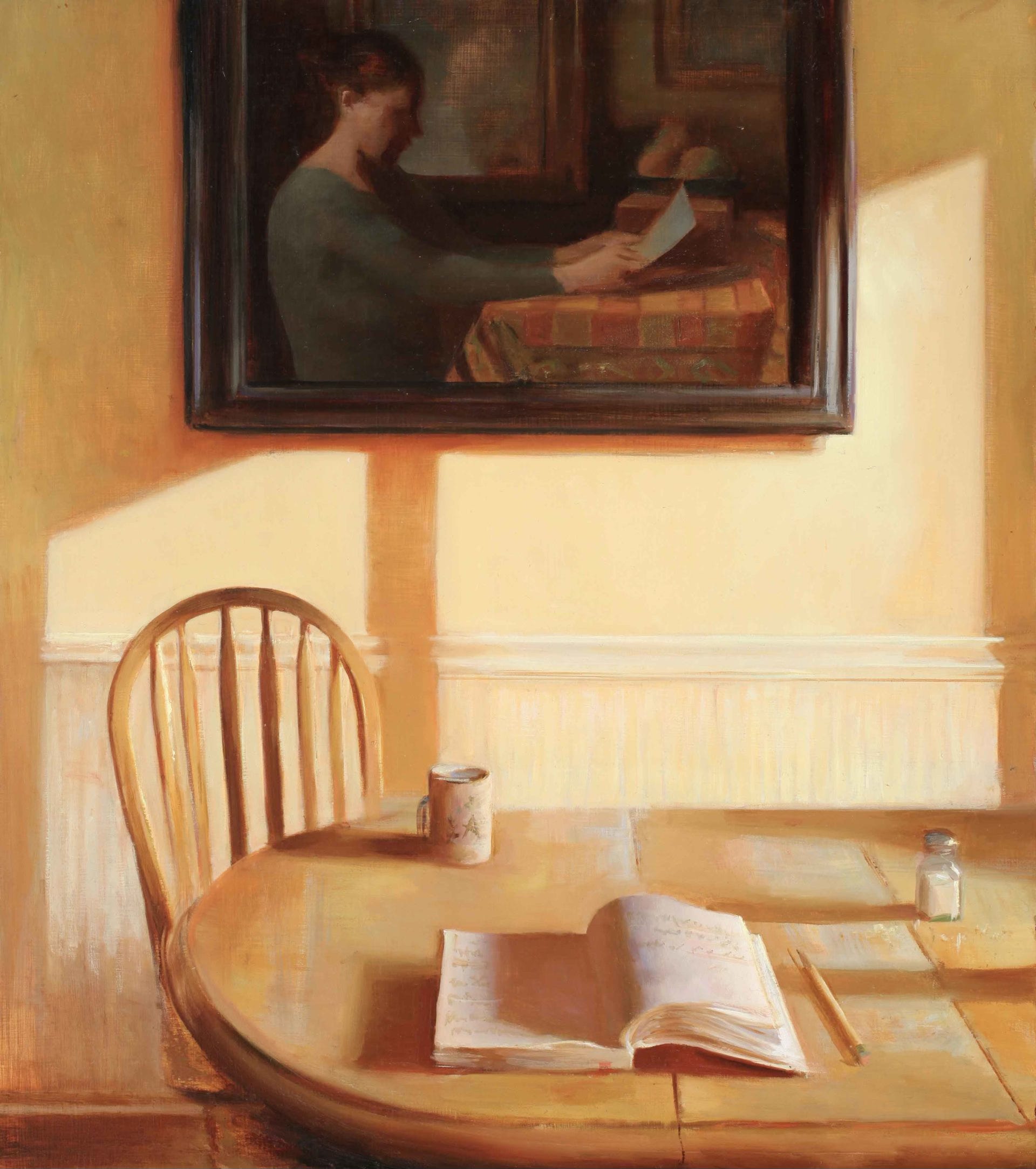
This painting illustrates the relationship over time between readers and writers by juxtaposing the classical painting of a woman reading a letter within the contemporary scene of a notebook at the kitchen table. This is my life! It tells the tale of how I relate to all of you who have stuck with me since I began this newsletter journey. Thank you for this wonderful relationship between reader and writer that sustains me through all my days. Let’s keep it going.
In the beginning, there was my aunt’s gift to a budding creative…
My aunt gave me a diary with a lock for my thirteenth birthday. Hardbound, white, with gilt edging, the diary set my heart a-flutter. I was a teenager with something to say.
“Why bother with that?” my mother said after everyone had gone home. “So impractical.”
Later, my mother warned me not to put anything in it I wouldn’t want someone else to read.
Instead of telling my truth I reported my days.
I bored myself.
Soon, the diary ended up in the back of my closet, then the trash when we moved again.
Now I think, who but her would steal it? We were the only ones in the house most of the time.
My mother, in her discouragement, prevented me from having conversations on the page that might have revealed who I was becoming to myself and, perhaps, to the mysterious thief who might break into my written conversational vault. She didn’t think I should risk that.
What she revealed of herself was that she didn’t want to know me or herself all that well. Too risky to address our truths, better to avoid all that vulnerability and simply carry on with the business in front of us—laundry, dishes, schoolwork—and not go searching for other business that might demand something real and true like joy and belonging, maybe believing in the possibility of these two things.

According to Wendell Berry1, if you don’t know where you are, you don’t know who you are. What then of a displaced person like me, who holds close to no particular geography or culture for that matter, the product of multiple migrations from the age of four?
Can the page be a place? A substitute for real estate? Is embracing the blank page what distinguishes writers—diarists—from others? By externalizing our thoughts into text, we build the scaffolding for our homes from words and whole interiors from stories.
Berry tells his story tethered to his land in Kentucky. What if I tell my story tethered to pages influenced by all I’ve witnessed and also by all I’ve ever read by others? Writing and reading develops knowledge, and isn’t that a kind of permanence, something no one can take away from me, just as Berry’s attachment to his land is eternal?

In her essay, “On Beauty”, Marilynne Robinson2 writes that stories define whole civilizations and as a consequence us. The self is a story.
Writing in my notebook gives me space to consider my own opinions and reactions to the world and modify them. This is a mark of a healthy consciousness, at least it seems so to me; for certainty appears to be the demon of our times, the destroyer of relationships and communities, maybe even whole societies.
This story I write of myself is subject to change as experience and reflection suggest modifications are needed to grow as a social creature and also a spiritual one with a moral code.
My brother never modified his narrative of our family. I have to assume he’s fine with that. He’s the only one who can change the story he tells himself. And it seems to me he’s too fragile to suppose that he is like King Lear—mistaken.
This is the man who refused to join me in putting our mother’s ashes to rest in the plot next to Dad’s.3 Who couldn’t be bothered with keeping me company on the trip. Who not only never forgave our mother her failures but also never loved me, the baby sister who was even more vulnerable than he, and for this reason received more attention. I contracted German measles (Rubella: the “R” in MMR) as a baby. I’m lucky to have only minor hearing loss in one ear today. He was almost thirteen years old at the time. He didn’t get sick.
For the longest time I looked up to him.
When did I outgrow him? Years before I wrote this part of our story. Yet, it wasn’t until I wrote it all down last summer that I understood this truth: He could not care less about being my friend.
My work is to accept this and move on with my own story, allowing it to loop and tumble through prisms and freshly polished lenses, backtracking on itself when necessary and spinning out a refreshed plot. This is the joy of consciousness and its peril.
My brother and I use the same language to bring coherence to our family’s story and arrive at vastly different conclusions.
“The mind is prolific in generating false narrative. Like the immune system, it can turn against itself, defeat itself.” 4
At least I’m aware of this mental flaw. Writing helps me identify when my mind is up to some trickery. Invariably this leads to compassion and often forgiveness.

Wallace Stegner once wrote that, “Both fiction and autobiography attempt to impose order on the only life a writer really knows, his own.”5 He understood how much the human mind seeks to bring order to the chaos of everyday life. Life is after all just one damn thing after another.
We don’t control who our parents are, where we are born, the quality of schools we attend, who buys the house next door, the behavior of others, or the landscapes that form us.
Sometimes, if we aren’t trying to convince ourselves of purpose we seek instead to prove there is no purpose. This in itself is a way toward sense-making by constructing an argument. We need to believe we matter, damn it, even in the chaos of the cosmos, and when we argue for the opposite we think our arguments matter.
As a species, we need to demonstrate awareness, consciousness. All genres of writing, be they fiction or nonfiction, seek to do this. Some of the truest things I’ve ever read exist in poetry, song and scripts meant for stage or screen.
Literature is an imitation of life. Even when distorting life it’s calling forth a story world from the writer’s experience, and the emotional landscape of her mind. She may set her story on a starship five hundred years into the future, but there is no doubt the nut of story hails from her deepest self.
I am still the person my first thirteen years made me. There is no escaping the uncontrollable facts of a childhood determined by parents who wandered. What did all that wandering get them? Right back where they began, but without the ties that might have made it the kind of community they could rely upon.
When you leave, people move on without you and they are in no hurry to renew relations upon your return. In fact, some of them have made up their own stories about you. You may have become a bit player in their lives despite family ties. This is why I had no ties strong enough to hold me in southern Ontario in 2007, when I left for Australia. Migration was normal for me. On some level I expected everything to work out even though the how of it remained opaque, and the notebook I kept at the time is full of worry and anxiety. I hoped the answers would unfold and they did. The universe caught me when I fell, just as I’d asked it to on the page. My notebook helped me trust my instincts in the present and also trust in the unknowable future.
All of the control I’d tried to hold on to once independent of my parents revealed itself as an illusion, maybe even self-delusion. I wasn’t being true to my nature before 2007. In seeking safety living as a suburbanite putting on a suit each day, wearing my hair in a bob and commuting to a job in the city that demanded compromises from me contrary to my nature, my story failed to tell the truth. I actually believed self-reliance was possible free from vulnerability.
This was a lie I told myself stemming from the fear of vulnerability I’d experienced as a child, reinforced by my mother. The time had arrived to alter the course of the plot of my life. No one could do this for me. I’ve kept a notebook ever since. It has no lock. A thief in the night will have to live with whatever he or she finds there.
Crossing to safety6 through vulnerability rather than in spite of it is a recurring theme in all of my writing. Everything I put on the page is a labor of love and also bafflement. I love my family and I am baffled by them. They are prologue to my story. To make sense of my life is to make sense of them. As a writer I apply my lens and weave our stories into something honest and true, a tapestry for a house framed with words.
This is why I bother.

Wendell Berry, What Are People For: Essays (Berkeley, CA: Counterpoint, 1990).
Marilynne Robinson, “On ‘Beauty,’” in The World Split Open (Portland, OR: Tin House Books, 2006), 121-129

Marilynne Robinson, “On ‘Beauty,’” in The World Split Open (Portland, OR: Tin House Books, 2006), 124.
Wallace Stegner, “The Law of Nature and the Dream of Man: Ruminations on the Art of Fiction,” in Where the Bluebird Sings to the Lemonade Springs: Living and Writing in the West (New York: The Modern Library, 2002), 219.
If you haven’t figured out by now, I am a huge fan of Stegner. I’m referencing his novel Crossing to Safety (1987) here in addition to the above referenced essay.
There is a real beauty to the meandering path of this piece, Martina. I think that meandering plus your reflections soften the harshness of your experience so that readers can take in the meanings and learn from them without flinching away. You are masterful at taking an object--a notebook--and evoking from it narrative and essential truths about being human in this life. Brava! And I love your signature at the end too.